
Tag: accommodation

  • Chiang Mai’s Historic Old City, Temples and Light Shows

    Chiang Mai’s Historic Old City, Temples and Light Shows

    Chiang Mai Old City – lined with a moat around, it was once the capital of the Lanna Kingdom in the 13th century. Today, the remnants of its city walls and gates still stand, offering a glimpse into its storied past. It is a town filled with cosmopolitan cafes, serene Buddhist temples, bustling local markets and the perfect base for day trips around Chiang Mai.

    Unlike the modern buzz of Bangkok with its sprawling malls and skytrains, the Old City feels like a laid-back cousin — a charming blend of history, spirituality and quaint urban cafes.

    A City of Temples

    One of the most remarkable aspects of the Old City is its density of temples — over 30 Buddhist temples (known as Wats) are packed into just 1.6 sq km. That’s more temples per square metre than almost anywhere in Thailand!

    Did You Know?

    • Thailand has over 40,000 temples.
    • Bangkok has more than 400.
    • Chiang Mai has over 300.

    No wonder it’s called the Land of Temples!

    If temple-hopping is on your list, the Old City is the best place to start. Here are some of the most significant ones to visit:

    • Wat Phra Singh – This is probably the most recognised temple and the most revered in the Old City. It is also known as the Golden Temple. Much of its architecture is covered in gold. Prominent in its grounds is its giant golden chedi, a distinctive feature that you surely cannot miss. The temple dates back to 1345 and houses the sacred relic of the Phra Singh Buddha, which is believed to have originated in Sri Lanka. 
    • Wat Chiang Man – This is the oldest temple, known as the first royal temple of Chiang Mai. It was built in 1296 by King Mengrai of the Lanna Kingdom. The temple sits tucked away near the northeast corner of the city, off Ratchapakhinai Road.
    • Wat Phan Tao – Built entirely of teak wood and often overlooked, it has a serene charm. Located next to the sacred Wat Chedi Luang, the temple was originally a throne hall for King Mahotara Prateth. Its origin dates back to the 14th century. It is also known as the “Temple of a Thousand Kilns” because of its historical role in producing Buddha images using numerous small clay kilns — especially during the Lanna period. Today, the temple is a key site for cultural festivals like Loy Krathong (Festival of Lights) and the Yi Peng Festival (Northern Thai Lantern Festival).

    The Temple of the Great Stupa – Wat Chedi Luang

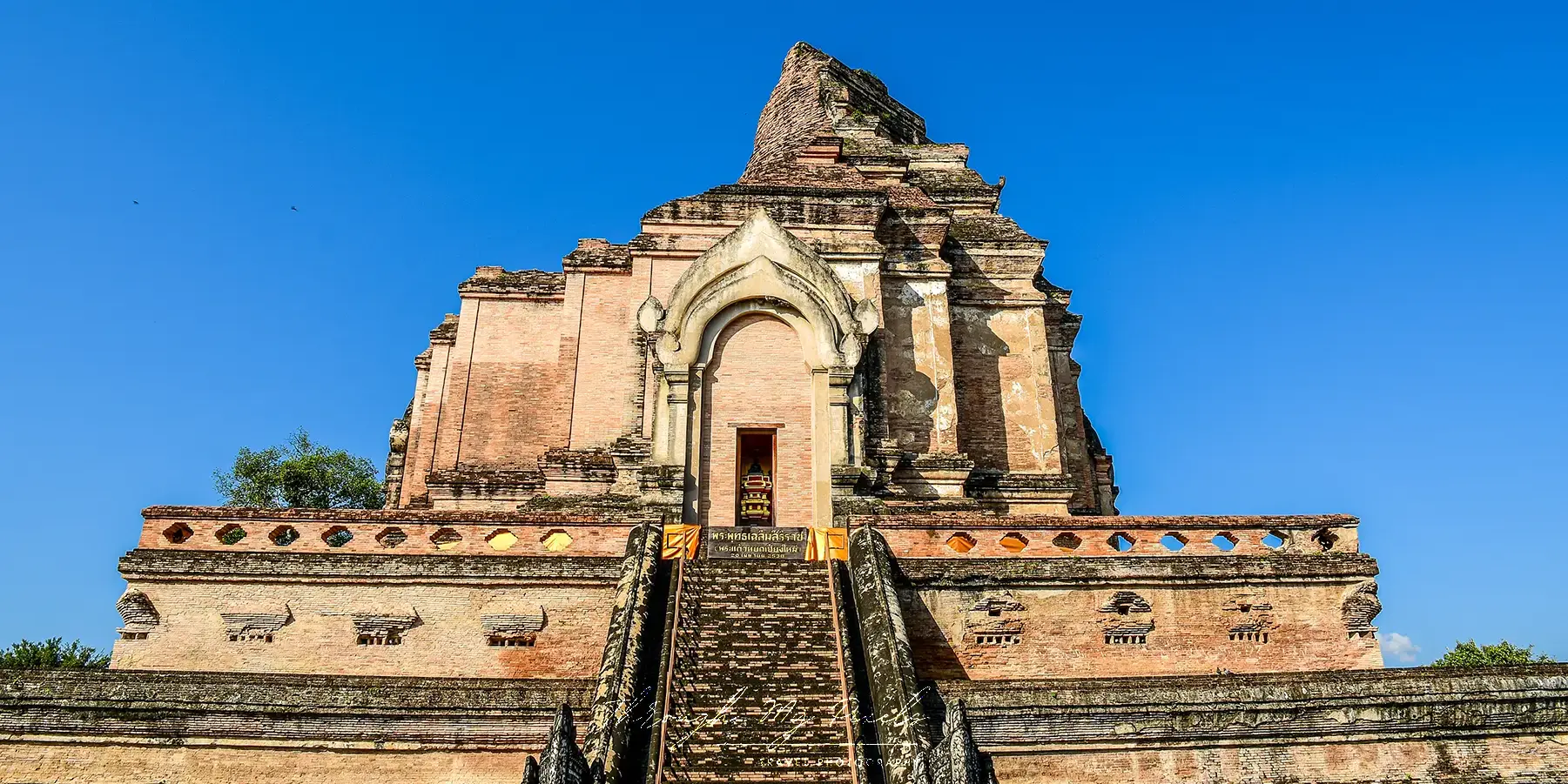
    For me, the highlight has to be Wat Chedi Luang, the feature image of my post. Don’t you think it has the Indiana Jones vibes?

    Distinct from the other temples, which are usually adorned with gold, this sacred temple has been preserved in its ruins.

    Building of the temple started in 1391 but it was only completed nearly a century later. Then, it was considered one of the largest temples with a 85m-tall chedi, giving it the name “Temple of the Great Stupa”. However, an earthquake in 1545 destroyed much of it and it was only partially restored in the 1990s.

    The temple is significant in the history of Thailand as it used to house the Emerald Buddha, Thailand’s most sacred relic, for about a hundred years. Following the earthquake, it was moved to Wat Phra Kaew in Bangkok in 1551. Now, what you’ll see is a replica at the top of the temple’s staircase.

    For me, there’s something truly special about photographing ruins like this — they preserve the spirit of the past and bring a mystical quality to every frame.

    But Wat Chedi Luang also has a modern look. Below are photos of the main viharn, which faces the main entrance. Dating back to 1928, it contains the large standing Buddha image Phra Chao Attarot. The viharn itself is quite an intricate work of art. So, interestingly, the entire site is a mixed of modernity and its past.

    A Photowalk Through the Old City

    Take time to also go on a leisurely stroll of the Old City. The streets are very walkable and easy to navigate, with the four gates (North: Chang Phuak, East: Tha Phae, South: Chiang Mai, West: Suan Dok) serving as key entry points. There’s always Google Maps if you really need help.

    Other than tourists on temple walks, you’ll also see the locals going about their day, street vendors selling ice cream and drinks from their push carts, tuk-tuks buzzing by, numerous massage shops, cafes to pop into for a quick coffee or tea break and of course, night markets, which are quite an Asian thing.

    So walk around, explore and snap photos to tell your story of Chiang Mai and its Old City.

    I’ve pinned down some of these locations in the map below for reference.

    The Charming Chiang Mai Flower Festival

    We stumbled upon this unexpectedly — and what a lovely surprise it was! I think it adds another dimension to the tour, where much of it has been about nature, sacred spaces and old towns – Doi Suthep, Doi Inthanon, Mae Kampong, Mae Rim. The Charming Chiang Mai Flower Festival showcases lights and technology. It’s about vibrance!

    The 2024 festival was held at the Chiang Mai PAO Park from 29 November 29 2024 to 5 January 2025. While details for 2025/2026 are yet to be announced, it usually takes place around the same time each year.

    It’s free to attend and open daily from 8.30am to 11pm. So, keep an eye on their Facebook page for the latest updates.

    Festival Highlights:

    • Stunning light displays
    • Hourly Fountain shows (7pm to 10pm)
    • ‘Live’ music performances
    • Firework displays
    • Night market and food stalls
    • Foral garden of tulips, orchids, and lilies during the day

    Consider staying at The Rim Resort

    The Old City offers a range of stays from charming guesthouses in quiet alleyways to boutique hotels with Lanna-style decor. One place I would recommend would be The Rim Resort.

    The resort is tucked along the quiet western edge of the Old City. While not in the city central, its quiet location offers the respite that you need, yet keeping you relatively close to what the city and the outskirts have to offer.

    Wat Phra Singh is a 5-min walk away, The Sunday Walking Street Market about 10min away and One Nimman and Maya Lifestyle Shopping Centre at the outskirts is a short tuk-tuk ride away.

    The accommodation is comfortable and homely. The rooms are quite spacious with separate bathtubs and showers, and the daily breakfast was delightful. Our room came with free welcome drinks and Thai snacks. We were also given a voucher to redeem a bowl of the famous Khao Soi at the restaurant and it was deliciously good! There are also free snacks available daily at the hotel lobby which is a treat especially for the young ones.

    What stood out most was its excellent customer service which puts us right at ease. They take great care of our needs whenever we need.

    Whether you’re travelling alone, as a couple or with children, I think The Rim will make a lovely stay.

    This post may contain affiliate links. If you click on them and make a purchase, I may earn a small commission at no extra cost to you. Thank you for your support!

    And that about wraps up what I wanted to share about Chiang Mai! There are so many more fascinating places and experiences I wasn’t able to cover this time. But perhaps that’s something to look forward to on my next visit to the former Lanna Kingdom. Until then, sawasdee ka!

    Klook.com
  • A serene stay at Hoshino Resorts Oirase Keiryu Hotel

    A serene stay at Hoshino Resorts Oirase Keiryu Hotel

    A trip to Oirase Gorge wouldn’t feel complete without staying at least one night at the Hoshino Resorts Oirase Keiryu Hotel. It’s the only accommodation located along the Oirase stream – perfect for fully immersing yourself in Oirase’s natural beauty. Nestled within the gorge, you can experience the lush forests and the gentle rush of the Oirase stream right at its doorsteps. It certainly makes for a great anniversary stay!

    The hotel is part of an award-winning and very well-known luxury hot spring and resort ryokan brand in Japan. You can tell from the above photo of its grand lobby to get a sense of how lux this establishment is. Rooms at this hotel are designed to blend beautifully with the surrounding nature. Large windows overlook the mountain stream. Some premium rooms even have private balconies with an outdoor bath where you can relax and listen to the water flowing by. Alas, I can only dream…

    Window view from Hoshino Resorts Oirase Keiryu Hotel
    Our window view from the room!

    Our stay

    We stayed in the Superior Room, a spacious 44㎡ room (huge by Japan’s standards) with twin beds, a bathroom and a sofa where we could sit and enjoy the gorgeous mountain view. Here’s a view of the room we stayed at.

    We booked the dinner and breakfast package and it did not disappoint. The buffet-style dining at the Aomori Ringo Kitchen featured some of Aomori’s finest produce – fresh seafood, seasonal vegetables, and hearty northern dishes. And of course, the hotel’s big onsen was such a luxury!

    Getting there (and out)

    We took the resort’s shuttle bus from JR Hachinohe station. The hotel offers direct shuttles only from JR Hachinohe Station or Aomori Station (or its sister property, Aomoriya).

    Important: Shuttle reservations are required, and they do fill up — so be sure to book early! I’d advise you to book early. Check here for the various options and timings.

    The resort shuttle for the return journey typically leaves in the morning (around 10–11am), which limits your time for exploring Oirase Gorge if you’re only staying one night.

    Our suggestion:

    • Take the shuttle in.
    • Skip the shuttle out — instead, hop on a JR bus back to JR Hachinohe Station (approx. 1hr 45min). You can check the schedule here.
    • Take note of the timing for the last bus so you don’t miss it. Also, some stops are not in operation during the late autumn or winter season.
    Shuttle bus directions
    • Alternatively, you can manage your own time and pace if you’re renting a car. Check out Klook for car rental deals.

    Here’s a sneak preview of what you get to experience at Hoshino Resorts Oirase Keiryu Hotel.

    Suggested itinerary

    Here’s a simple plan if you’re staying one night:

    Day 1

    • Arrive by shuttle and check in.
    • Go for a short walk to explore the nearby surroundings (ideally before sunset at ~4pm in autumn).
    • Soak in the onsen with hot spring waters from Mt Hakkoda. Try the outdoor bath for a magical experience under the crisp mountain air.
    • Enjoy the scrumptious dinner at Aomori Ringo Kitchen — definitely worth booking in advance!
    • Explore the resort’s charming interiors and cosy atmosphere.

    Day 2

    • Wake up early and head out to explore more of Oirase Gorge.
    • Not keen on walking? You can book a seat on the open-top sightseeing bus (3,850yen/pax). It runs round-trips to Lake Towada, with two daily departures — but only operates between May to early November (we missed it, unfortunately).
    • If you are staying for more than a night, consider signing up for other activities like moss ball making workshop, Oirase Lamp making workshop, guided walks (in Japanese) and afternoon tea by the river.

    You really can’t go too far wrong with Hoshino Resorts and Oirase Gorge. For us, it was a great way to celebrate our anniversary and a memorable time spent. Will you give this a try?

    This post may contain affiliate links. If you click on them and make a purchase, I may earn a small commission at no extra cost to you. Thank you for your support!

    (P.S. Here’s the resort’s video clip of the open-top bus ride — a great way to get a preview!)

    Book quality hotels and ryokans in Japan at Rakuten Travel

  • Discovering Quintessential Aomori

    Discovering Quintessential Aomori

    Relaxing. Chilly. Quiet. If you have been to Tokyo, Aomori is the opposite. With fewer people and a slower pace, it truly feels like a getaway. Plus, it has a lovely bay area, if you like the sea.

    I took these photos during our early morning walks to catch the sunrise at the Aomori Bay, about a stone’s throw from Dormy Inn, where we stayed for four nights. Walking down, albeit almost freezing at 1°C during a November autumn morning, with your other half to view the glorious sunrise and the peaceful morning is pure bliss.

    Where is Aomori?

    Aomori illustrated map image

    Aomori is located at the northern tip of Japan’s main island, just south of Hokkaido. It is a large prefecture made up of 10 cities, 22 towns and 8 villages. Three regions make up the area. The Mrs and I visited two during our 20th wedding anniversary last autumn – the Tsugaru region which includes the cities of Aomori and Hirosaki and the Nanbu region with Oirase Gorge and Lake Towada. The third region is Shimokita which we didn’t have time for. The Aomori prefecture is part of the larger Tohoku region which also includes the prefectures of Iwate, Miyagi, Akita, Yamagata, Fukushima, and Niigata. For more information on Aomori, visit here.

    Aomori in Autumn

    We visited Aomori in Autumn but we’ve been told that it’s also great in the other seasons. There’s something for everyone every season. Spring is great for Sakuras of course, especially at Hirosaki Castle and its park. In summer, there is the vibrant and colourful Nebuta Festival. Winter transforms Aomori, known as the snowiest city in the world, into a magical wonderland. And then there’s autumn with the beautiful red, orange and yellow foliage or “koyo” (紅葉) in Japanese. The trees almost glowed in golden sunlight. We found ourselves constantly pausing to take it all in. The air was crisp, and the colours were vivid—almost like walking through a painting.

    You can check here for Japan’s autumn foliage forecast. According to the forecast, the best time to view koyo in 2025 is between mid-November to late November. But the forecast may change nearer to the date. Autumn arrived late by about two weeks last year.

    Aoiumi Park in autumn
    The changing colours of the trees at Aoiumi Park – from green to yellow/orange to red – on 14 November 2024.

    Just chill and explore

    Aomori City is quaint. There are no mega malls or rows of big shopping centres like in the major cities of Tokyo and Osaka. Its streets are quite old-school, giving a laid-back, suburban vibe. In the streets near the Aomori station, when you hear a melodious chime, you know it’s time to cross the road. Yes, they are pedestrian crossing chimes. I can still hear the melody in my head – “Mi-So-Do-Mi-Re-Re-Do-Do-Ti-La-La…”. We love the tune! It’s as if we are transported back in time.

    There are many small shops, eateries, restaurants and cafes along its streets. There was one we kept going back to. It wasn’t anything fancy or one of those “must-eat” kind of places but whenever we were there, the place was packed. It was simply simple, affordable and tasty authentic Japanese food that just fills you after a long day out. That restaurant is Ootoya at 1-chōme-8-6 Shinmachi, Aomori, Japan, 030-0801. We love their Black Vinegar Chicken and Vegetables! There’s a recipe for this that I found on the internet. Have yet to try it.

    Another place that we love is this cosy little cafe – Coffee Marron at 2-6-7 Yasukata, Aomori 030-0803 Aomori Prefecture. It has a pretty high rating on Tripadvisor and Tabelog.

    Coffee Marron
    Coffee Marron

    Where to stay?

    We love onsens, so we love Dormy Inn Aomori! It’s so great after a long day out to soak in the hot baths and if you are game, they also have a little outdoor bath where you can soak under the chilly autumn night sky. 気持ちいい~!(Kimochi ii~! which means feels good or pleasant)

    Dormy Inn Aomori
    Dormy Inn Aomori

    Another wow factor for us is the… Apple Juice! I swear, after tasting the fresh Aomori apple juice, you won’t want to drink any other apple juice. The apple juice was really really good. We would drink it whenever we could. We wanted to buy packs of it back to Singapore and thought we would be able to find them easily in Tokyo on our way back. Big mistake. We couldn’t find any. We were sorely disappointed. So, if you love apple juice like us, please get them while you are in Aomori.

    We ended up scouring online stores from Singapore — yes, that’s how hooked we were. We ordered them online via Redmart – Seiken Japanese 100% Natural Aomori Apple Juice – and they weren’t cheap. It’s about S$7/pack. The other one we tried – JA Aoren Aomori Pure Apple Juice – which also tasted good was from Yukiyama via Lazada. That’s about S$8/bottle. They weren’t the same ones that we drank over there but they were still good and you can get them at very good deals during monthly sales like 7.7 and 11.11, etc. If you are in Aomori, try looking out for these two brands below. Dormy Inn Aomori serves them.

    Aomori apple juice
    Aomori apple juice

    So why is Aomori apple juice so good? That’s because Aomori produces 50 million tons of apples annually and they are among the world’s best in quality. I’ll share more about their apples in my next post.

    Oh, besides apple juice, Dormy also serves free coffee in the morning, free ice cream and probiotic drinks after the onsen, as well as a hot bowl of soba every night.

    This post may contain affiliate links. If you click on them and make a purchase, I may earn a small commission at no extra cost to you. Thank you for your support!

    Getting to Aomori

    Aomori location

    You can take a domestic flight to Aomori from Tokyo which takes about 1hr and 20min, or you can get onto the Tohoku Shinkansen from Tokyo Station to Shin-Aomori Station and connect to Aomori Station. We took the Shinkansen. Here’s what we did.

    1. Arrange luggage delivery to the hotel in Tokyo as we will be there for the latter part of our journey. You can arrange for the delivery at Yamato Transport, Terminal 3, 2F, Delivery Service Counter (open from 5.45am) after customs clearance, or at Terminal 2, 2F, Delivery Service Counter.
    2. Exchange JR East rail pass and book reservations for Shinkansen to Aomori at JR Office (open 6.45am), Terminal 3, 2F, after customs clearance or Terminal 2 Tourist Service Counter.
      • Tip: If you are going to be at Aomori or the Tohoku region for at least 5 days and travelling quite a bit within, I suggest getting the JR East Tohoku Area rail pass for about S$263 (adult) or S$131 (child) which is quite value-for-money as it provides unlimited travel across JR East lines, including local, limited express, and express trains, Shinkansen, Tokyo Monorail and buses etc. Or get the 6-day JR East-South Hokkaido Rail Pass for S$317 (adult) and S$159 (child) if you want to go to Hokkaido as well. The Hokkaido Shinkansen connects Hakodate city and Aomori city in one hour.
    3. Train Route: Haneda Airport to Aomori Station
    Taking train to Aomori

    There are many ways to get to Aomori via train. You can use Japan Travel to plan your routes. I find it pretty useful in providing me with detailed information and offers various options as well. The entire journey can take about 4 hr.