
Have you walked the new heritage trails yet?
If you haven’t heard, five trails have been added to the Walking Trails @ CDC initiative, a programme by the Community Development Councils in partnership with GovTech Singapore and CrowdTaskSG.
The first five trails were launched in August 2025, taking walkers along landmarks and neighbourhoods around Singapore, including the Rail Corridor, Bukit Timah Railway Station, Victoria Concert Hall, Punggol Digital District, East Coast Beach and Little Guilin @ Bukit Gombak.
Walking Trails @ CDC (Heritage Edition)
These five new Heritage Edition trails, launched in March 2026, have already drawn many Singaporeans. This latest addition is a collaboration with the National Heritage Board, designed to bring Singaporeans closer to Singapore’s rich heritage through an engaging and rewarding walking experience. While digital participation is currently available only to Singaporeans, visitors are still welcome to follow the routes and explore the checkpoints at their own pace.
The concept remains the same as the earlier trails: complete all five checkpoints, including two tasks at each stop, and receive a S$5 RedeemSG voucher. Catch all six Ollies along the way to earn an additional S$10 voucher. That’s a possible S$15 reward for simply clocking steps and discovering Singapore, and up to S$75 if you complete all five trails. The vouchers can be used at participating supermarkets such as Fairprice, Sheng Siong, etc.


These Ollies actually guide you towards the next checkpoint. There are many of them but they are really elusive. It’s not easy to catch all six of them! It took me the fourth walk before I managed to catch all Ollies. For these new trails, 200 Ollies are up for grabs each month for six months.

The five Heritage Edition Trails are:
- Central Singapore – Walking Trails @ CDC: Kampong Glam
- North East – Walking Trails @ CDC: Tampines
- North West – Walking Trails @ CDC: Woodlands
- South East – Walking Trails @ CDC: Bedok
- South West – Walking Trails @ CDC: Jurong
It’s really not difficult. Each trail spans about 4km and takes approximately 1.5 to 2 hours at a leisurely pace. That was how long it took a group of friends and me, with plenty of time to soak in the surroundings and snap photos. I’ve done four walks now — three of the new ones and one older trail. It doesn’t have to be just about walking — it can easily turn into a fun photography outing too.
The Central Singapore Heritage Trail: Kampong Glam
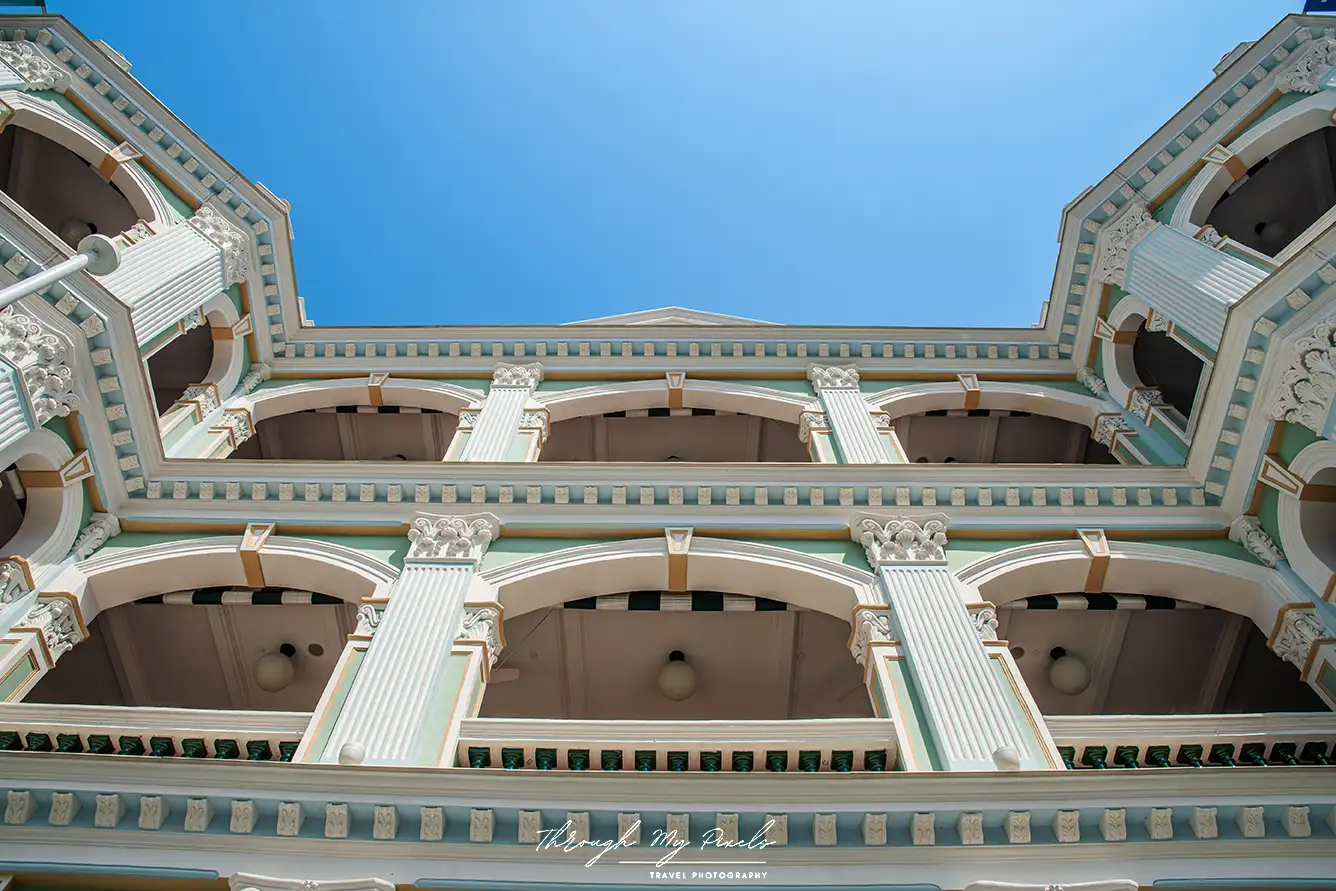
My first walk was the Kampong Glam trail. This starts at the Peranakan Museum on Armenian Street and ends at the Jalan Besar Stadium.
Checkpoint 1 – Peranakan Museum

It’s fairly easy to get to the museum, just a 10-min walk from three MRT stations – City Hall (East-West/North-South Lines), Bras Basah (Circle Line) and Bencoolen (Downtown Line).
Peranakans — generally known as Straits Chinese — are a Southeast Asian community of mixed Chinese and Malay or Indonesian heritage. You’ve probably heard the terms Babas and Nonyas, which refer to Peranakan men and women respectively. Their rich culture has been made familiar to many Singaporeans through popular dramas such as The Little Nyonya and Emerald Hill.
If you’re interested in learning more about the Peranakan heritage — from the nyonya kebaya (traditional outfit for women) and cuisine like ayam buah keluak to oral traditions such as the pantun (traditional Malay poetic form) — this museum is a wonderful place to start.


Did you know?
The building was the former Tao Nan School from 1912 to 1982. Philanthropist Dato Lee Kong Chian was once a student there. The museum is also located where the first Botanic Garden was situated.
Checkpoint 2 – Bras Basah Complex
Walking past landmarks such as the historic Cathedral of the Good Shepherd, St. Andrew’s Cathedral and the Singapore Management University, you’ll eventually arrive at the second checkpoint — Bras Basah Complex, an iconic destination that was especially significant in the 1980s.


Back then, it was a popular venue for Singapore xinyao (新谣) singers to launch and promote albums. For the uninitiated, xinyao refers to a uniquely Singaporean genre of Mandarin songs written and performed by local youths, and it played an important role in shaping the nation’s music scene.
If you are interested in knowing more about the evolution of xinyao, catch Mediacorp’s “Tuesday Report: Encounter Under The Stars 星期二特写”. Here’s the YouTube video of episode one.


The Complex also earned the nickname “City of Books” because of its many bookstores. It was likewise a go-to destination for art students in search of materials and supplies. Even today, it retains much of its original identity, with language centres, music stores, and art galleries still occupying its corridors. A nod to its artsy and vibrant heritage, the building is now illuminated with colours and adorned with murals that reflect the creative spirit of the precinct.
Earlier, on 7 and 8 March, the Complex hosted an open house featuring live performances, movie screenings and a creative craft market to mark the Bras Basah-Bugis precinct’s continuing journey as a creative district.
Checkpoint 3 – Masjid Sultan
It’s impossible to miss the majestic golden dome of Masjid Sultan or Sultan Mosque, the next checkpoint. Built in 1824, it remains both the heart of Kampong Glam and an important landmark for Singapore’s Muslim community.


The district itself is a fascinating mix of Malay, Arab, Chinese, Indian, and European influences. In the early 19th century, it was designated by Sir Stamford Raffles for the Malay, Arab, and Muslim communities, becoming home to merchants, sailors, and families from across the Malay Archipelago. Today, it’s filled with colonial-era shophouses, boutique shops, cafés, and vibrant street art. Haji Lane, in particular, is one of the most Instagrammable spots in Singapore, attracting tourists year-round!

Checkpoint 4 – Golden Mile Food Centre
Many locals still fondly know this as the “Army Market.”
In the past, army boys would come here to buy boots, socks, towels, and military essentials. Over time, it has transformed into a place for street fashion and vintage attire.


Food-wise, this stop is also a real treat. Built in 1975 to resettle hawkers from the old Jalan Sultan street market, it is known for heritage favourites such as Hokkien mee, braised duck rice, curry chicken noodles, and Peranakan dishes. Long queues often form around its old-school stalls, where recipes and flavours have been passed down for generations. These days, the centre also features a growing mix of contemporary and fusion stalls, from pasta and grilled meats to inventive dishes that reinterpret local flavours.
Here’s a good article about its rich history and another on its food, if you’re interested.
Final Checkpoint – Jalan Besar Stadium


Walking past the HDB flats along Beach Road and North Bridge Road and across the Rochor Canal, you’ll finally reach the final checkpoint – Jalan Besar Stadium.
For football fans, this location needs little introduction. Opened in 1929, it is often regarded as the birthplace of Singapore football and has hosted many iconic matches, including the Malaya Cup and Malaysia Cup.
Today, the 8,000-seater stadium is the home ground of the Singapore Premier League club Young Lions and the headquarters of the Football Association of Singapore.
My Takeaway
It’s a fairly easy route to walk, especially in the morning. Still, be prepared for Singapore’s heat. Stay hydrated, wear a cap, and remember to apply sunscreen, as there are stretches of the journey with little to no shade. Because of that, I’d definitely recommend doing the trail either in the morning or in the evening.
Overall, I found it to be an enjoyable route through the city. Catching the Ollies was both fun and frustrating, especially since I didn’t manage to catch all six. Still, that added an extra layer of excitement to the walk.
What I really appreciated was how the trail brought me to places I had never visited before, such as Bras Basah Complex and Jalan Besar Stadium. It’s great to have a trail that guides you to these locations while helping you learn a little more about Singapore through the tasks at each checkpoint.
And for the photographer in me, it was the perfect excuse to slow down, notice the little details, and capture everyday moments and architecture that might otherwise go unnoticed.

